Research, published and explored.
Publications by our team and commentary on methods shaping optimization, modelling and decision science.
Team publications
Papers and preprints by the mathematicians behind Meromorphic.
Equilibrium in the Canonical Stackelberg Triopoly via Response Functions and Fixed Point Theory
Response-function and fixed-point analysis of equilibrium in a canonical Stackelberg triopoly.
arXiv:2604.26487. Under review at Decisions in Economics and Finance.
A Failed Cartel: When Collusive Firms Become Competitors
A model of competition that emerges when one firm leaves a cartel.
Preprints.org manuscript 202608.0988 (2026).
Equilibrium in a Failed Cartel: Set-Valued Reactions and Sources of Market Asymmetry
Set-valued reaction models for equilibrium and market asymmetry after a cartel member exits.
Preprints.org manuscript 202608.0503 (2026).
A Fixed Point Approach to the Stackelberg Model in Oligopoly Markets
Fixed point methods applied to leader–follower competition in oligopoly markets.
Scientific Works of the University of Plovdiv, Mathematics, Vol. 40, Book 3, pp. 55–68. ISSN 0204–5249.
Commentary on external research
Technical explanations of published methods, their applications and the conditions that shape their use.
Haris IllahiUnsplash LicenseIllustrative photograph of a container terminal. Better routes. Real constraints.
PyVRP connects a practical routing solver to the capacity and timing rules that make delivery planning difficult.
Based on Niels A. Wouda, Leon Lan and Wouter Kool. INFORMS Journal on Computing 36(4), 943–955 (2024).
Andreas GücklhornUnsplash LicenseIllustrative photograph of solar arrays in Offingen, Germany. Predict for the decision.
Smart Predict, then Optimize asks a better question than forecast accuracy alone: what happens to the decision?
Based on Adam N. Elmachtoub and Paul Grigas. Management Science (2022); first published online in 2021.
Shavr IKUnsplash LicenseIllustrative photograph of industrial machinery. Choose the next experiment.
BoFire brings Bayesian optimisation and experimental design closer to the constraints of practical chemistry.
Based on Johannes P. Dürholt and coauthors. Journal of Machine Learning Research 26(204), 1–7 (2025).

Johann Dréo / NojhanCC BY-SA 3.0Pareto frontier: a trade-off between two objectives.Unmodified artwork, scaled to fit. Artwork remains CC BY-SA 3.0. Plan beyond one forecast.
Wasserstein distributionally robust optimisation makes uncertainty about the data-generating distribution part of the decision.
Based on Peyman Mohajerin Esfahani and Daniel Kuhn. Mathematical Programming 171, 115–166 (2018); online 2017.
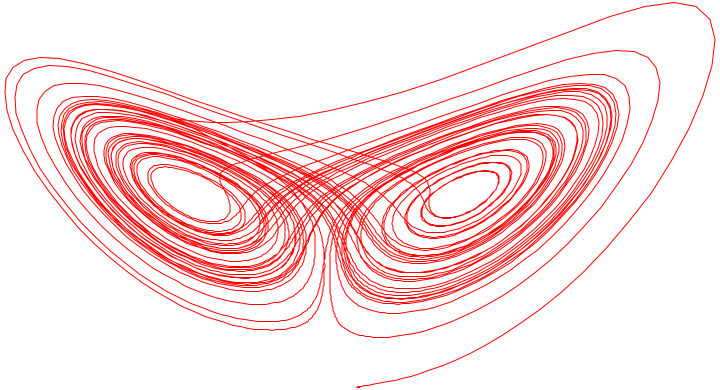
CepheusPublic domainLorenz attractor: an illustration of nonlinear dynamics.Unmodified artwork, scaled to fit. Find equations in the data.
SINDy searches for compact dynamical models that can be inspected, rather than only returning a prediction.
Based on Steven L. Brunton, Joshua L. Proctor and J. Nathan Kutz. Proceedings of the National Academy of Sciences 113(15), 3932–3937 (2016).


From sine waves to a square wave.
Explore how adding harmonics improves a Fourier approximation, and why an overshoot persists near a discontinuity.
Fourier convergence · square wave
Sₙ(x) = 4/π Σ sin((2k+1)x)/(2k+1)
Develop an idea into a working method.
Partner with us on mathematical research, algorithm development or an applied prototype.