Hard problems deserve better mathematics.

We build mathematical models and software that help companies improve operations, evaluate designs and make decisions under uncertainty.

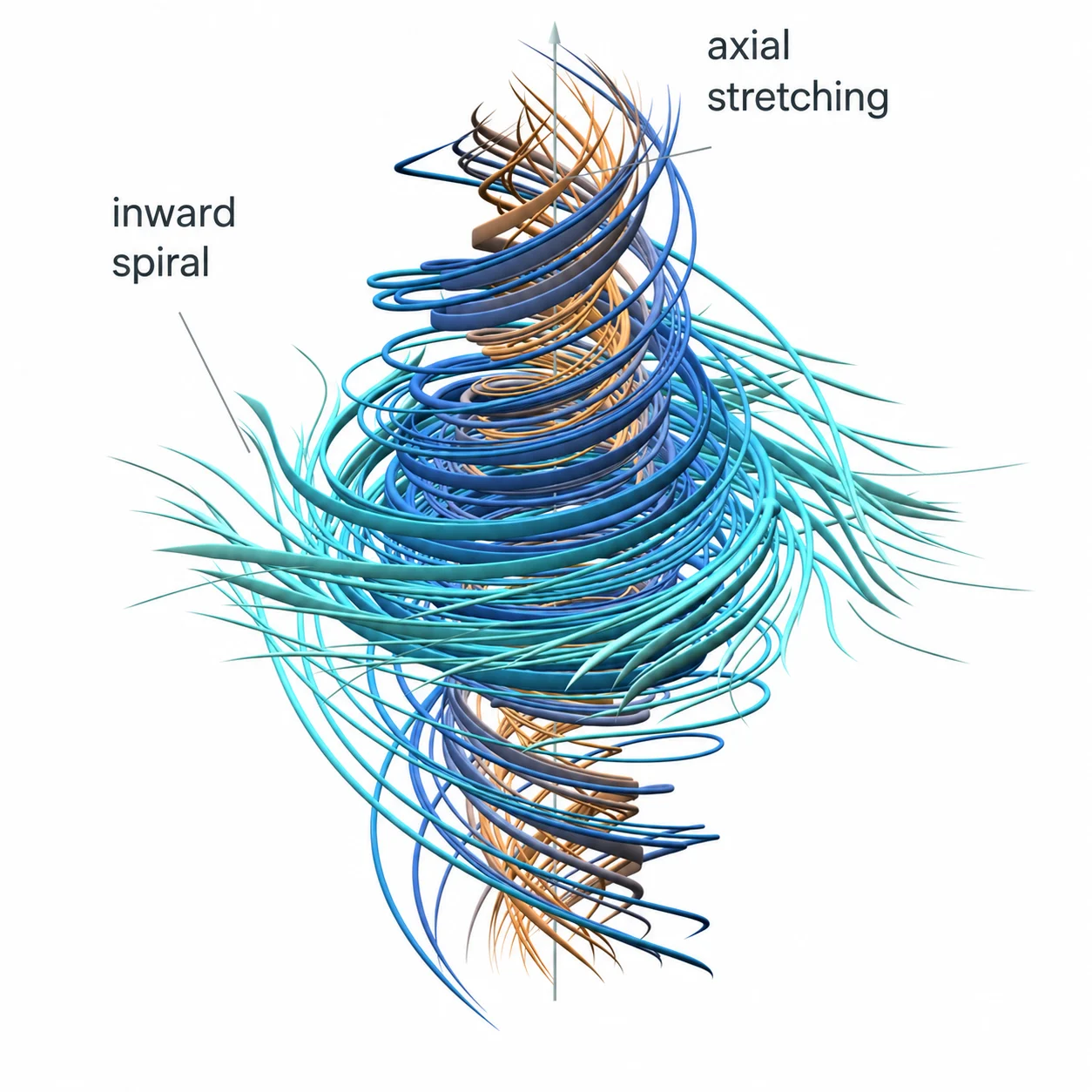
Fluid-motion visualization labelled ‘inward spiral’ and ‘axial stretching’, with blue, teal and orange trajectories circling a vertical axis.

Models, algorithms and decisions.

Specialist mathematical support for operational, engineering and research teams.

  1. Optimization

    Allocate resources, recover schedules and improve routing across complex operations.

    MethodsMathematical programming, combinatorial optimization, network models

  2. Simulation

    Test changes to a process before committing equipment, capital or operating time.

    MethodsDiscrete-event simulation, Monte Carlo, dynamical systems

  3. Mathematical modelling

    Translate physical, economic and operational relationships into models that explain system behaviour.

    MethodsDifferential equations, inverse problems, numerical analysis

  4. Decision intelligence

    Connect forecasts and uncertain data to decisions about capacity, investment and operations.

    MethodsStatistical inference, risk analysis, decision-focused learning

  5. Research prototyping

    Turn a research question into a working algorithm, numerical experiment or software prototype.

    MethodsScientific computing, algorithm development, machine learning

Explore our services

See the mathematics at work.

Flagship demonstrations from our library of five. Each is computed by a real model on a stated scenario, with its limits written down.

Expected delay cost per day over 16 unseen days, vessel six hours late: original plan €172k, first come first served €294k, optimised plan €113kOriginal€172kFirst come€294kOptimised€113k

Fictional terminal, vessel six hours late. Mean delay cost per day on 16 simulated days the optimiser never saw.

Port operations

Problem
A late vessel, a crane fault or a jammed gate spreads through berths, cranes, tractors and the yard within hours.
Result
With one vessel six hours late, the optimised berth plan cuts expected delay cost by 34%, from €172k to €113k a day, on 16 simulated days it never saw.
Method
Discrete-event simulation, simulation-based plan search, parallel evaluation
Why it matters
Test recovery plans against many possible days before committing berths and cranes.
Explore port operations
Stored battery energy over example day 69: the risk-aware controller keeps a reserve into the cloudy afternoon, the forecast controller does not600 kWh00:0024:00

Stored energy over one day with a cloudy afternoon: risk-aware controller solid, forecast controller dashed.

Energy dispatch

Problem
Run a battery behind a tight grid connection when tomorrow's prices are known and its clouds are not.
Result
Over 300 simulated days, the risk-aware controller cuts the cost of the worst days (CVaR 95%) from €1,016 with a rule-based controller to €788, close to the €774 only hindsight could reach.
Method
Stochastic dynamic programming, entropic risk, Monte Carlo
Why it matters
Choose how much protection against bad afternoons is worth paying for.
Explore energy dispatch
Leak probability across the district from four pressure loggers, with the two loggers the model suggests next

Leak probability from four loggers (larger, darker = more likely). Squares: loggers. Rings: the two loggers the model suggests next.

Water leak inference

Problem
Locate a hidden leak in a district network from night flow and a few noisy pressure readings.
Result
Four pressure loggers narrow a burst to 2.2 km of main to survey for 90% confidence; two more, placed where the model suggests, cut that to 140 m.
Method
Hydraulic network solver, Bayesian inference, information-based sensor placement
Why it matters
Prioritise excavation and decide where the next sensor pays for itself.
Explore water leak inference

Research depth. Practical application.

Meet Meromorphic
  1. Research depth

    Our team of researchers applies mathematics to challenging business and engineering problems.

  2. Working models

    Five interactive demonstrations, each computed by a real algorithm, cover operational scheduling, energy, inference and engineering design.

  3. Practical delivery

    Engagements produce documented models, decision tools and prototypes for your technical and operational teams.

From theory to application.

Selected research by our team, and our commentary on published methods that shape optimization practice.

  1. Preprint 2026

    Equilibrium in the Canonical Stackelberg Triopoly via Response Functions and Fixed Point Theory

    Response-function and fixed-point analysis of equilibrium in a canonical Stackelberg triopoly.

    Anton Badev, Martin Pavlov, Boyan Zlatanov

    arXiv:2604.26487. Under review at Decisions in Economics and Finance.

  2. Preprint 2026

    A Failed Cartel: When Collusive Firms Become Competitors

    A model of competition that emerges when one firm leaves a cartel.

    Anton Badev, Vanya Ivanova, Diana Nedelcheva, Martin Pavlov, Boyan Zlatanov

    Preprints.org manuscript 202608.0988 (2026).

  3. Preprint 2026

    Equilibrium in a Failed Cartel: Set-Valued Reactions and Sources of Market Asymmetry

    Set-valued reaction models for equilibrium and market asymmetry after a cartel member exits.

    Anton Badev, Vanya Ivanova, Diana Nedelcheva, Martin Pavlov, Boyan Zlatanov

    Preprints.org manuscript 202608.0503 (2026).

  4. Publication 2025

    A Fixed Point Approach to the Stackelberg Model in Oligopoly Markets

    Fixed point methods applied to leader–follower competition in oligopoly markets.

    Martin Pavlov, Vasil Zhelinski, Boyan Zlatanov

    Scientific Works of the University of Plovdiv, Mathematics, Vol. 40, Book 3, pp. 55–68. ISSN 0204–5249.

Commentary on external research

  1. Diagonal rows of blue solar panels separated by grass and service tracks.
    Andreas GücklhornUnsplash LicenseIllustrative photograph of solar arrays in Offingen, Germany.

    Predict for the decision.

    Smart Predict, then Optimize asks a better question than forecast accuracy alone: what happens to the decision?

    Based on Adam N. Elmachtoub and Paul Grigas. Management Science (2022); first published online in 2021.

  2. An industrial hall containing pipework, machinery and production equipment.
    Shavr IKUnsplash LicenseIllustrative photograph of industrial machinery.

    Choose the next experiment.

    BoFire brings Bayesian optimisation and experimental design closer to the constraints of practical chemistry.

    Based on Johannes P. Dürholt and coauthors. Journal of Machine Learning Research 26(204), 1–7 (2025).

Put mathematics to work on your next decision.

Discuss an operational challenge, an engineering question or a research project with our team.