

The idea
Brunton, Proctor and Kutz identify nonlinear dynamics by selecting a small number of terms from a candidate function library. The resulting equations aim to balance explanatory simplicity with agreement with observed behaviour.
What the authors established
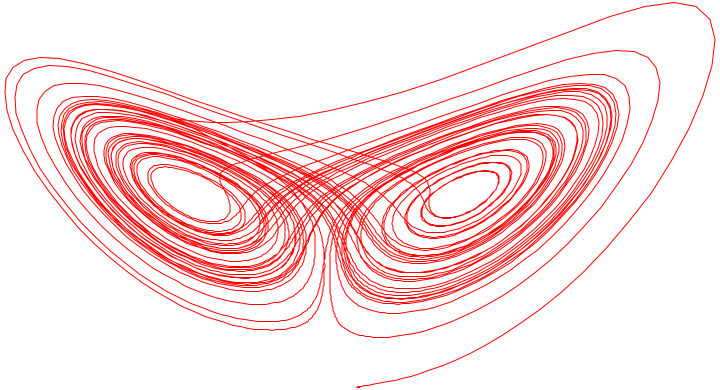
The paper demonstrates sparse model identification on systems including oscillators, Lorenz dynamics and a fluid-wake example. Its central opportunity is an inspectable dynamical model rather than an unconstrained black-box predictor.
Applications
Sensor histories can support compact process models when the variables and candidate terms reflect the underlying physics. Held-out trajectories test how well the identified equations generalise.
Where care is needed
The choice of coordinates and basis, informative measurements and noise treatment are important. Chaotic trajectories may diverge even when broader dynamics are captured. Identified equations require independent physical validation.
Sources and credits
- Discovering governing equations from data by sparse identification of nonlinear dynamical systems
Steven L. Brunton, Joshua L. Proctor, J. Nathan Kutz, published
Proceedings of the National Academy of Sciences 113(15), 3932–3937 (2016).
SINDy is the cited authors’ method. The Lorenz illustration is separately credited.